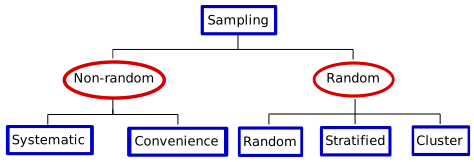
Click on an object to learn more about the different sampling techniques.
Random sampling can also be thought of as a 'pick a name out of the hat' technique. Samples are chosen from a population either by using a random number table or a random number generator. Each member of the population has an equal, independent and known chance of being selected.
The population is divided into subgroups (strata) based on specific characteristics, such as age, gender or race. Within the strata random sampling is used to choose the sample.
A school of $1000$ students are classified as follows:
Find a stratified sample of $200$ students for this population.
Suppose we are interested in how each of these groups will react to this statement: everyone in this school has an equal chance of success. Relying on a random sample may under-represent the minority populations of the school (people with blonde hair). By grouping our population by hair colour, we can choose a sample ensuring each group is represented according to its proportion of the population. So $57$% of the sample should be brunette, $29$% should be redhead and $14$% blonde. Within each group (strata) you select your sample randomly. As our sample consists of $200$ people, $114$ should be brunette, $58$ should be redhead and $28$ should be blonde.

|900 px
Data is divided into clusters and random sampling is used to select whole clusters. The sample will be obtained from a collection of entire cluster groups. It is usually used with naturally occurring groups of individuals for example classrooms, city blocks or postcodes.
The children in a classroom are divided up depending on which table they sit at. A sample can be obtained from this classroom by choosing $n$ number of tables to represent the class.

|900 px
All data is sequentially numbered and every $n$th piece of data is chosen. The number $n$ is chosen by $\displaystyle n=\frac{\text{size of population}}{\text{desired population size}}.$
In a class of 14 students, 4 names are chosen out of the hat for an assignment. Systematically sampling them would mean choosing every 3rd student in the class.

|900 px
Data is chosen based on convenience.
A sample is chosen from a classroom by the $n$ number of children sat nearest the teacher.

|900 px
Multistage sampling is where a combination of sampling techniques is used. For example cluster sampling and random sampling.
Test yourself: Numbas test on methods of sampling